ARCHETYPE 03
ヤンデレYandere
Love—with the safety turned off.
consuming devotion + no safe boundaries
A signal, not the whole characterSeen in the wild
Characters with this energy
These examples show the pattern at work. No character fits inside a single word.
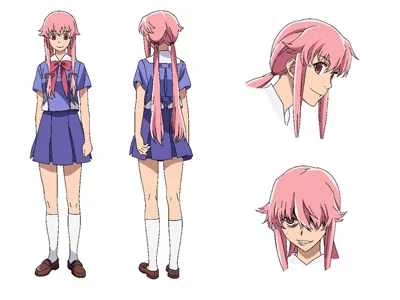
我妻由乃
Yuno Gasai
Future Diary
Official character sheet · © Sakae Esuno/Kadokawa/12 Diary HoldersThe signal
A yandere says “I love you”—then reveals that the “you” is no longer allowed to be separate. Maybe the danger creeps in. Maybe it is there from the start. The real signal is not a knife, pink hair, or one frightening expression. It is devotion that no longer recognizes the beloved’s autonomy.
The name is usually explained as a blend of yanderu, being emotionally or mentally unwell, and dere-dere, being lovestruck. But language is messier than the fandom formula. The root verb yamu has a broad history around illness and distress, as Kotobank’s entry for 病む shows. “Yandere” is a dramatic character label. It is not a medical category.
The familiar version is sweet first, dangerous later. But that is one staging, not a rule. A story can reveal the danger early, hide it behind an unreliable viewpoint, or show affection and menace at once. The pattern holds when attachment becomes permission for surveillance, isolation, manipulation, coercion, or harm.
What changes under pressure
Pressure makes the yandere’s world smaller. A rival becomes a threat to remove. Rejection means the beloved must be confused. Privacy looks suspicious. “No” becomes an obstacle instead of an answer.
That narrowing is what makes the type frightening. The feeling may be sincere. It may even be tender. Sincerity still does not make it safe. A strong version lets us follow the emotional logic of each escalation while seeing the violation clearly. We can understand the path without approving where it leads.
Violence is common because anime and manga can make obsession spectacular. It is not the definition. Control, threats, dependency, and relentless monitoring can carry the pattern without physical violence. And a violent character without devotion-driven fixation is not automatically yandere.
Why it works
The yandere turns romance inside out. Total devotion sounds flattering—until “total” becomes literal. The type tests the line between being cherished and being possessed, intimacy and access, sacrifice freely offered and sacrifice demanded.
The suspense comes from unstable alignment. Protector and captor. Ally and threat. The person most committed to the protagonist—and the person least able to hear “no.” That contradiction can drive horror, black comedy, tragedy, or a heightened thriller.
Example reading
Yuno Gasai of Future Diary is the modern emblem because love and danger become the same survival mechanism. She is resourceful, attentive, and fiercely protective of Yukiteru. She also stalks, confines, deceives, and kills. The series never asks us to doubt her attachment. It asks what that attachment becomes in a world built around fear and elimination.
Reading Yuno as “the crazy girlfriend” misses the construction and the cost. Abuse, a lethal game, unstable identity, and a desperate attempt to force one future into existence all shape her conduct. None of that excuses her violations. It makes her more specific than the shorthand.
Don't flatten the character
Never use “yandere” as a casual diagnosis of a real person. It does not appear in the World Health Organization’s ICD classification system. Mental illness does not predict the theatrical violence of a genre trope. Equating them stigmatizes people and makes the fiction less interesting.
Keep the ethical center clear: another person’s boundaries matter, even when the love is genuine. Then ask the richer questions. What fear makes separation unbearable? Does the story glamorize control, condemn it, or hold both reactions in tension? Can change happen without ownership? The label should sharpen those questions. It should never turn suffering into a punch line.